Vasculitis
Takayasu Arteritis
Affects large and medium sized vessels (especially aorta)
Females age <30 years old
HTN & Stroke
Smooth narrowing of aorta, with preference for left subclavian artery
Dialysis Fistula Evaluation
There are also loop grafts which are not mentioned in article above
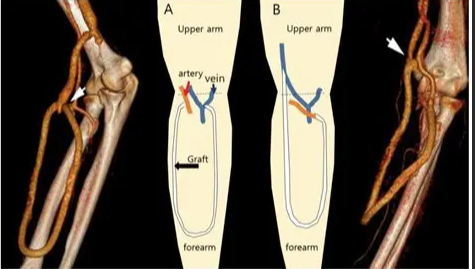
Loop Graft
Figure 1. Configuration of the forearm loop access. Either superficial veins located in the antecubital fossa (A) or the basilic vein right above the elbow joint (B) can be selected as an outflow vein. When comparing with the antecubital veins as the outflow, the basilic vein above the elbow joint provides an almost parallel course to the graft. (Arrow: venous anastomosis).
Cystic Adventitial Disease
Non-atherosclerosis causes of vessel stenosis and claudication
Caused by mucin containing cysts in the adventita of the vessel wall
Causes a scimitar sword or sprial appearance of the vessel on angio
M>F
Look for men with no RF for cardiovascular disease
Popliteal artery is the vessel affected in ~90% of cases
Most common tx = cyst resection and vascular bypass
Fibromuscular Dysplasia
Dysplastic growth of smooth muscle and fibrous tissue affecting small and medium vessels
F>M
Look for this in young adult females with refractory HTN
String of beads on angio
Tx = balloon angioplasty
DO NOT PICK STENTING
References: